Beyond Green Curry: Building an Isaan Table in a British Kitchen
Photo: Kenamparo, CC BY-SA 4.0, via Wikimedia Commons
If your idea of Thai food is coconut milk, sweet basil and a takeaway carton, Isaan will come as a welcome shock. In Thailand's northeast, the food is built on sticky rice, charcoal smoke, lime, chilli and fermented fish. It is loud, tart and deeply savoury, and it has more in common with the cooking of neighbouring Laos than with the creamy curries of the south. For British cooks, it is also surprisingly easy to put on the table.
Why Isaan tastes different
Isaan is the large northeastern region of Thailand, bordering Laos and Cambodia. Historically poorer and less visited than the central plains, it developed a cuisine of thrift and intensity. Sticky rice is the staple, eaten with the fingers and used to mop up juices. Grilled meats, especially chicken, are everywhere. Salads are tart with lime and fish sauce rather than sweet. Fermented fish, known as pla ra, gives many dishes a deep, pungent savour. Coconut milk is rare. This is not a cuisine of richness; it is a cuisine of edge.
The British shopping list
You do not need a specialist Thai grocer to cook a good Isaan meal, though a trip to one will improve things. From British supermarkets: chicken thighs, minced pork, limes, garlic, coriander, mint, spring onions, cucumbers, little gem lettuce, fish sauce, palm sugar or light brown sugar, dried chilli flakes, jasmine rice for toasted rice powder. From an Asian grocer or online: Thai glutinous rice, tamarind concentrate, dried shrimp, green papaya, lemongrass. If you cannot find green papaya, firm carrot and white cabbage make a decent stand-in for som tam; the dressing is the point.
Sticky rice without a bamboo basket
Thai glutinous rice is not pudding rice and not sushi rice. It is sold as sweet rice or glutinous rice in Asian grocers and online. Soak it for at least four hours, or overnight. Drain it, then steam it in a bamboo basket set over a wok, or in a fine-mesh colander lined with muslin. Steam for 20 to 25 minutes, turning once, until the grains are tender and cling together. Keep it warm in the basket or a covered bowl. It should be sticky enough to pinch into a small ball, not gluey.
Som tam: the salad that wakes up a table
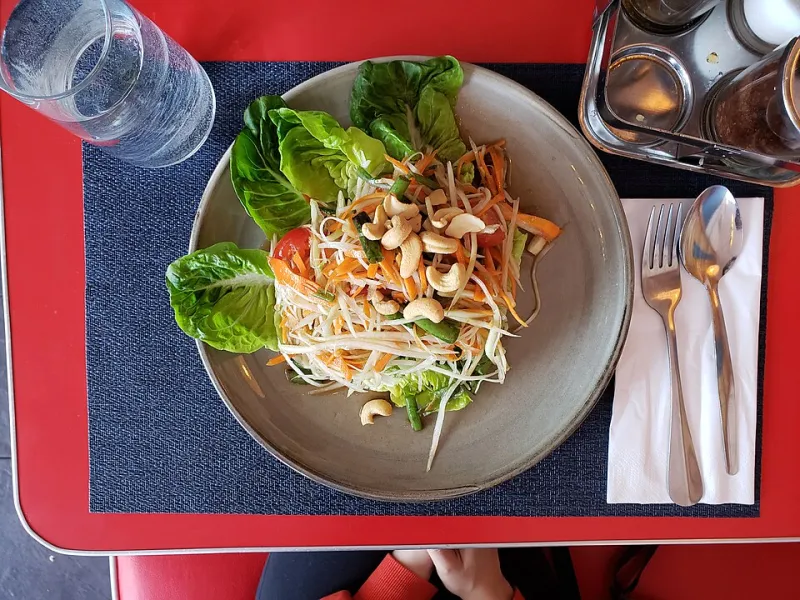
Som tam is the dish that converts people. Green papaya is shredded into matchsticks, then pounded with garlic, chillies, dried shrimp, peanuts, palm sugar, lime and fish sauce. In Isaan, it often includes pla ra; for a British kitchen, fish sauce and a little shrimp paste can approximate that savoury depth. Use a large mortar if you have one, or bash the ingredients in a bowl with the end of a rolling pin and toss. The balance should be sour first, then salty, sweet and hot. Serve it with sticky rice and grilled chicken and watch the table go quiet.
Charred chicken and nam jim jaew
Gai yang, or grilled chicken, is the heart of many Isaan meals. Marinate chicken thighs in garlic, coriander root or stems, white pepper, fish sauce, a little palm sugar and lemongrass. Leave it for a couple of hours, then grill over charcoal if you can. A disposable barbecue or a hot grill pan works. The skin should char in places. Nam jim jaew is the dipping sauce: tamarind, fish sauce, lime, palm sugar, chilli powder, toasted rice powder and coriander. It is sour, smoky and hot, and it makes plain rice taste like an event.
Larb and the toasted rice powder
Larb is minced meat, pork or chicken, cooked quickly and dressed with lime, fish sauce, chilli, shallots, mint and toasted rice powder. The rice powder is easy: toast raw jasmine rice in a dry pan until golden, then grind it coarse. It thickens the juices and adds a nutty, toasted note. Do not skip it. Larb should be served warm or at room temperature, not piping hot, with plenty of herbs and lettuce leaves for scooping.
Building the spread
For four people, cook a pot of sticky rice, make som tam, grill chicken thighs and put out a bowl of larb. Add nam jim jaew, cucumber, lettuce and extra herbs. Everyone takes a little rice, pinches it into a ball, dips it in the sauce and eats it with the salad and meat. It is informal, fast and generous. A cold lager or a pot of jasmine tea works well.
Isaan food deserves to be as familiar in Britain as green curry and pad Thai. It is not difficult, it is not expensive, and it does not need a long list of imported ingredients. It just asks you to turn up the lime, the chilli and the char.