The Quiet Sunday Roast: Khao Man Gai and the Case for Gentle Cooking
Sunday lunch in Britain is a ritual of crackling, gravy and a roasting tin that has seen better days. It is also, quietly, a test of patience. Khao man gai - the Thai chicken rice that turns up on street corners from Bangkok to Chiang Mai - asks for a different kind of patience. No blast of heat. No bronzed skin. Just a bird slipped into barely trembling water, rice cooked in its fat, and a sauce sharp enough to wake the whole table. It is not a roast. It is something gentler, and it deserves a place beside the Sunday standards.
Why a poached bird makes sense on a British Sunday
The British Sunday roast is an oven performance. Khao man gai is a stovetop one. That shift alone makes it useful. You are not juggling a screaming hot oven, a tray of potatoes and a bird that needs basting every twenty minutes. You are poaching a chicken slowly, cooking rice in the resulting broth, and making a small, fierce sauce while the kitchen fills with ginger and coriander root. It is calmer. It is also, in its own way, more generous: the whole bird goes further, the broth becomes part of the meal, and nothing is carved in a panic at the table.
The dish has Hainanese roots and a firm place in Thai cooking, especially in Bangkok and the central plains. But you do not need a family history to cook it. You need a chicken, some jasmine rice, a few aromatics and a sauce that knows how to be sharp. That is a very British kind of shopping list, even if the result tastes like a holiday.
Buying the bird: free-range, smallish, and not too cold
A 1.6-1.8kg free-range chicken is the sweet spot for four people with rice. Anything much larger will poach unevenly and leave you with meat that is either chalky at the breast or stubborn at the thigh. Buy the best bird you can reasonably afford - a free-range supermarket chicken is fine, a butcher's bird is better - and bring it out of the fridge half an hour before you start. Remove the giblets. If there is a little excess fat around the cavity, keep it: it will go into the rice.
This is not a dish that hides a mediocre chicken under spice. The poaching liquid is gentle, the skin is pale, and the flavour of the bird has nowhere to go but the rice and the broth. Good free-range chicken tastes of something. That matters here.
The poach: barely a bubble
Find a pot that holds the chicken snugly. Cover it with cold water, then add a thumb of ginger, a few smashed garlic cloves, coriander root if you have it, two spring onions, a teaspoon of white peppercorns and a good pinch of salt. Bring the water up to a bare tremble - around 80-85C, with small bubbles rising slowly rather than a rolling boil - and keep it there. A rolling boil will toughen the meat and cloud the broth.
Poach for 45-55 minutes, depending on the size of the bird, then check the thigh at its thickest point. It should read 75C on a thermometer, and the juices should run clear. Turn off the heat and let the chicken rest in the liquid for twenty minutes. This is not optional: the rest finishes the cooking gently and keeps the breast moist. Lift the bird out, strain the broth, and skim the fat. You will need some of that fat for the rice, and the rest of the broth for serving.
The rice: fat, aromatics, and a little patience
Rinse 300g jasmine rice until the water runs mostly clear. In a wide pan, render the chicken fat you saved with a sliced shallot, a grated garlic clove and a little grated ginger. Add the drained rice and toast it in the fat for a minute or two, until the grains smell nutty. Pour in about 450ml of the hot poaching broth - the rice should be just covered - add a knotted pandan leaf if you have one, and cook covered on the lowest heat for 12-15 minutes. Let it sit off the heat for ten minutes before fluffing.
The rice should be glossy, savoury and faintly sweet from the chicken fat. It is the heart of the dish. Do not rush it, and do not drown it.
The sauce: sharp, salty and not shy
Khao man gai needs a sauce that can cut through the richness. In a small bowl, mix two tablespoons of fermented soybean paste (tau jeow), one tablespoon of light soy, one tablespoon of white vinegar, a teaspoon of sugar, one or two finely chopped bird's eye chillies, a little grated ginger, a grated garlic clove and a squeeze of lime. Taste it. It should be too sharp and too salty on its own. Against the rice and chicken, it will settle into place.
Some tables add a second sauce of dark soy and chilli, or a ginger and spring onion oil. Both are good. Start with the fermented soy version and see where the meal takes you.
The table: cucumber, coriander and a bowl of broth
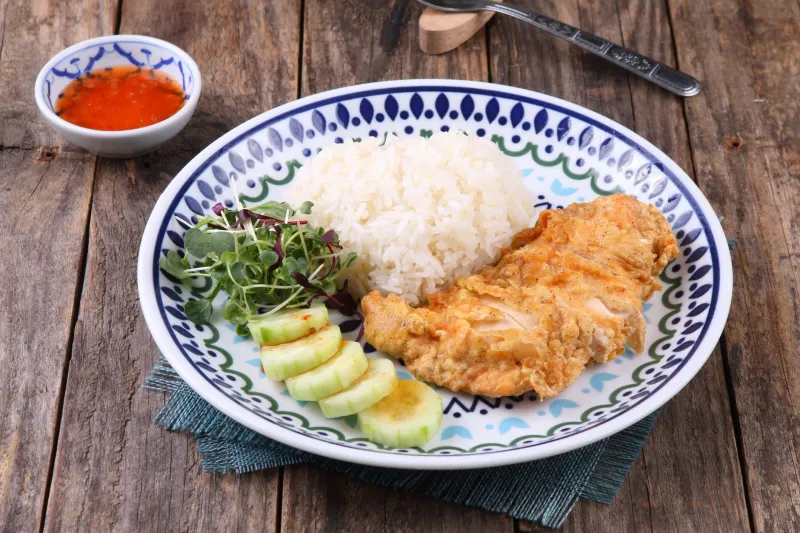
Serve the chicken sliced or shredded, the rice packed into small bowls and turned out, and the sauce in a jar with a spoon. Add cucumber spears, coriander leaves, sliced spring onion and a few pickled chillies. Put the hot broth in a jug. This is a Sunday lunch that asks you to sit down, not stand up carving. It is quiet, but it is not plain.
Monday: the leftovers worth planning for
Any cook who has made a Sunday roast knows the pleasure of Monday. Khao man gai leftovers are even better behaved. Shred the remaining chicken and warm it in the broth with a handful of rice for a quick congee. Or make a cold rice salad with cucumber, coriander, lime and a spoonful of the sauce. The broth can be frozen in portions and used as a base for noodle soup later in the week. A Monday lunch that tastes like someone thought ahead is a small, real luxury.
At Sukothai Kitchen we are not asking you to abandon the roast. We are asking you to make room for a bird that is poached rather than roasted, rice that is perfumed rather than plain, and a sauce that wakes everything up. It is a different kind of Sunday showpiece - one that rewards a gentle hand and leaves you with a Monday worth looking forward to.